
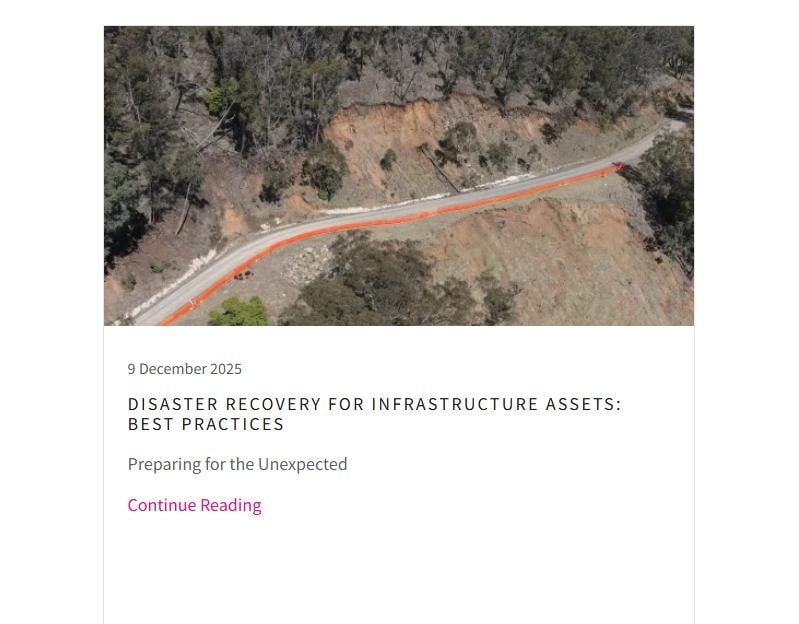
Disaster Recovery for Infrastructure Assets: Best Practices
Preparing for the Unexpected — the frameworks, planning tools, and rapid-response protocols that protect critical infrastructure assets when disaster strikes.
Australia's infrastructure is exposed. Floods, bushfires, storms, and landslides regularly damage roads, bridges, culverts, and drainage systems — and the frequency and severity of these events is increasing. For asset owners and managers, the question is no longer whether a disaster will affect their network, but when, and how prepared they will be when it does.
Best practice disaster recovery for infrastructure assets begins long before any event occurs. The organisations that recover fastest from disasters are invariably those that have invested in pre-event planning: asset condition data, vulnerability assessments, pre-positioned response contracts, and clear internal escalation protocols.
Asset condition data is the foundation. You cannot prioritise recovery works without knowing the pre-event condition of your assets. Councils and road authorities that maintain current bridge inspection records, pavement condition data, and drainage asset registers are able to identify damage quickly, distinguish pre-existing defects from event-caused damage, and prepare accurate funding submissions. Those without this data spend weeks in the assessment phase that better-prepared organisations complete in days.
Pre-positioned response contracts — standing arrangements with civil contractors and engineering consultants that can be activated without a full procurement process — are increasingly recognised as essential infrastructure in their own right. The DRFA framework supports the use of pre-positioned contracts, and councils that have them in place consistently achieve faster response times and better value for money than those procuring in the immediate aftermath of an event.
During the response phase, the priority is safe access. Temporary reinstatement of critical transport links — even at reduced capacity — allows emergency services to operate, communities to access essential services, and the recovery effort to begin. Permanent restoration can follow once the immediate crisis has passed and proper design can be undertaken.
The betterment principle is central to modern disaster recovery practice. Simply restoring an asset to its pre-event condition, when that condition made it vulnerable to the event that damaged it, is poor value for public money. DRFA betterment provisions allow eligible assets to be upgraded to a higher standard — reducing future vulnerability and long-term maintenance costs. Identifying and documenting betterment opportunities is a key part of the post-event assessment process.
Finally, the recovery phase is an opportunity to learn. Post-event reviews that capture what worked, what didn't, and what should be done differently next time are invaluable — but they require deliberate effort to conduct while the experience is fresh. The organisations that improve their disaster resilience over time are those that treat each event as a source of data, not just a problem to be solved.
Saba Civil Management and Consultancy
Civil Engineering & Infrastructure Specialists — NSW & Australia Wide
Have a project or question?
Our team is ready to help with your civil engineering and infrastructure needs.