
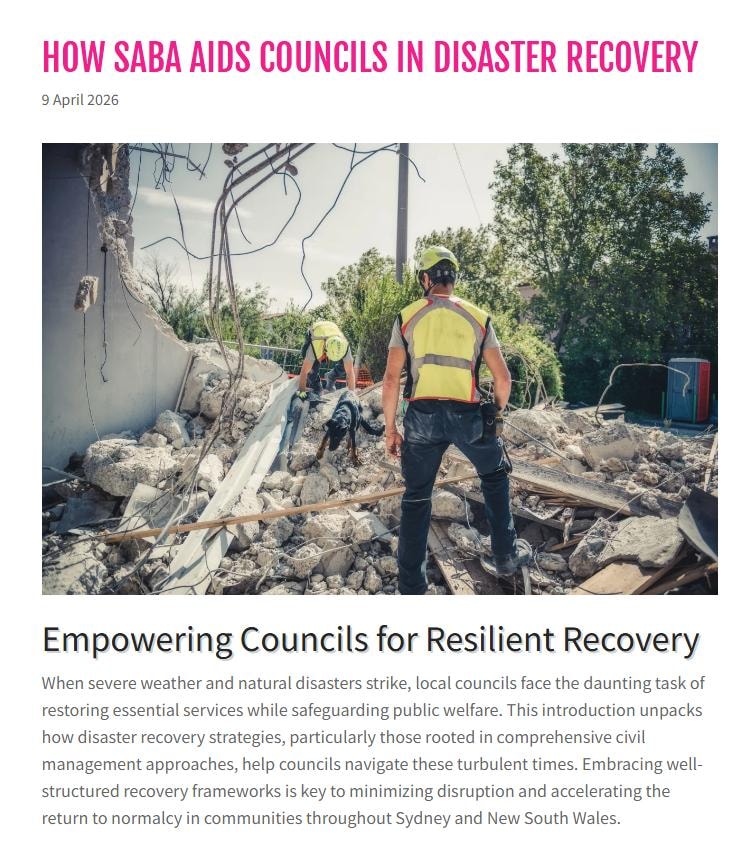
How SABA Aids Councils in Disaster Recovery
Empowering Councils for Resilient Recovery — a look at Saba Civil's rapid mobilisation process and how we partner with Local Government Authorities after flood events.
When a major flood event strikes, the clock starts immediately. Roads are cut, bridges are compromised, and communities are isolated. For Local Government Authorities, the pressure to restore access and assess damage is enormous — and it arrives at the worst possible time, when internal resources are already stretched to their limits.
Saba Civil's disaster recovery capability is built around one principle: be ready before the call comes. Our team maintains standing mobilisation protocols that allow us to deploy assessment crews within 48 hours of a flood event. We carry pre-positioned equipment, maintain current knowledge of regional road networks, and have established relationships with the councils and agencies we work alongside.
The first phase of any disaster recovery engagement is rapid damage assessment. Our engineers conduct systematic inspections of affected road corridors, bridges, culverts, and drainage infrastructure — documenting defects, assessing structural integrity, and prioritising works by safety risk and community impact. This assessment forms the basis of the council's funding submissions to state and federal disaster recovery programs.
Funding navigation is often where councils struggle most. The intersection of DRFA (Disaster Recovery Funding Arrangements), state betterment programs, and council's own capital works budgets is complex. Our team has direct experience preparing and supporting funding submissions, and we work with councils to ensure that eligible works are correctly scoped, documented, and claimed.
The permanent restoration phase requires careful sequencing. Temporary access reinstatement must be achieved quickly, but permanent works need to be designed to a higher standard — incorporating betterment measures that reduce vulnerability to future events. Getting this balance right is the core of what we do, and it's why councils who have worked with us through one disaster tend to call us first when the next one arrives.
If your council is looking to strengthen its disaster recovery preparedness — whether that means pre-event planning, standing panel arrangements, or post-event response — we'd welcome the conversation.
Saba Civil Management and Consultancy
Civil Engineering & Infrastructure Specialists — NSW & Australia Wide
Have a project or question?
Our team is ready to help with your civil engineering and infrastructure needs.